What Is The Best Way To Light An Outdoor Kitchen For Night Cooking?
A luxury outdoor kitchen is used most after sunset, and most of them are lit as if they were gardens. Here is how to layer task, ambient, and safety lighting so the cook can see the food and guests can see each other.
Layer Task, Ambient, And Safety Lighting Separately
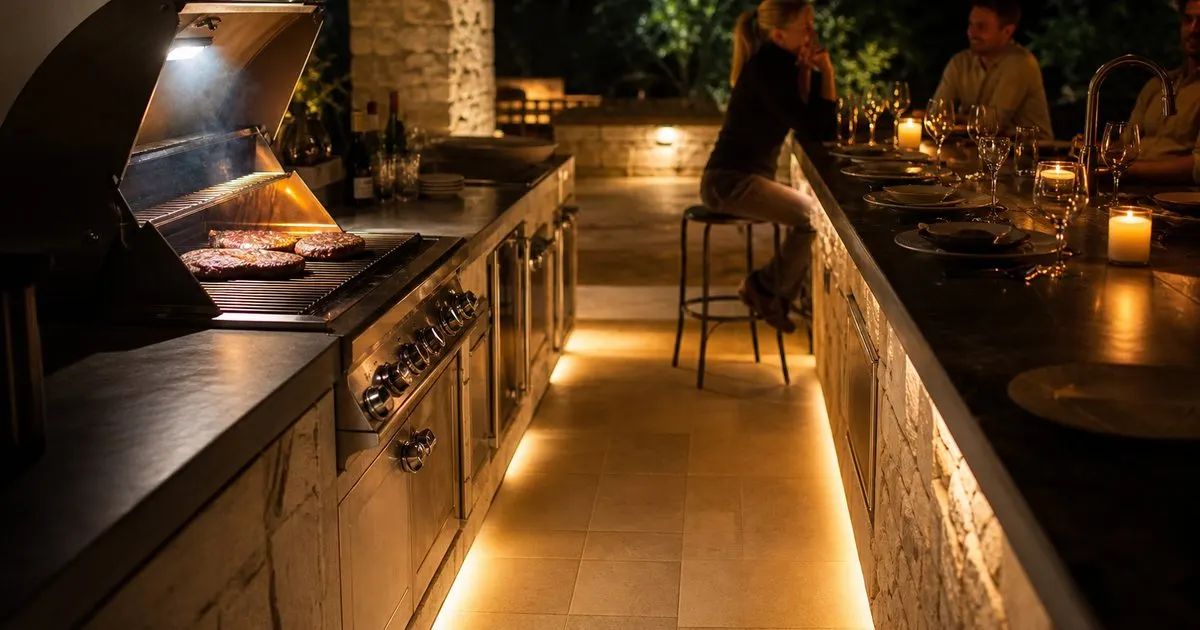
Good outdoor kitchen lighting is three systems wearing one aesthetic. Task lighting puts bright, focused light on the grill grates, the cutting board, and the sink so the cook can judge doneness and avoid a knife slip. Ambient lighting sets the mood across the seating and dining area at a much lower level. Safety lighting marks steps, level changes, and the path back to the house. When all three are put on a single switch at a single brightness, the kitchen is either a stadium or a cave. Related: How Do You Plan A Luxury Outdoor Kitchen That Lasts For Years?
Design each layer for its job and control them separately. Task lights should be on their own circuit or dimmer so they can be turned up while cooking and down once the food is served. Ambient lights should be dimmable and warm. Safety lights should stay on all evening at a low level regardless of what else is happening. A control plan drawn before the electrician arrives costs nothing; adding a separate dimmer after the stone is set costs a great deal.
Keep reading: How Do You Plan A Luxury Outdoor Kitchen That Lasts For Years?, What Materials Truly Survive Years Of Sun, Rain, And Winter Frost?, Which Grill Fuel Best Suits A High End Outdoor Cooking Space?. See how Emberkitchn helps you the design guide to luxury outdoor kitchens and grills.
Where The Fixtures Go And Why Overhead Alone Fails
The single most common failure is a handsome pendant or a pergola mounted downlight placed above the grill. When the cook stands at the grill, their own head and shoulders block that light, and the grates fall into shadow exactly where it matters. Grill task light needs to come from in front of or beside the cook, typically from a hood mounted light, from lights built into the grill itself, or from a fixture mounted on the structure at an angle that clears the cook's body. Related: Are Built In Kitchens Better Than Freestanding Grills For Serious Entertaining?
Counter task light works best from below a raised bar or from fixtures mounted under an overhead structure that sits forward of the counter edge. Under counter strip lighting along the toe kick is excellent for ambient glow and for marking the kitchen's footprint at night, but it does not light the work surface and should not be counted as task lighting. Put a small dedicated light over the sink, because rinsing and draining in the dark is how a good chef's knife ends up in the garbage disposal.
Color Temperature, Glare, And Bugs
Warm white light, in the range that reads as candlelight rather than office, flatters food, stone, and people, and it is the sensible default for ambient layers. Task lighting can run slightly cooler so that the cook can judge the color of meat accurately, but the jump between layers should be modest or the grill will look like a workshop bolted onto a lounge. Ask for fixtures with a high color rendering ability, because cheap outdoor light often turns a beautifully seared steak an unappetizing gray. Related: What Materials Truly Survive Years Of Sun, Rain, And Winter Frost?
Glare ruins more outdoor evenings than darkness does. A bare bright source at eye level, whether a wall sconce beside the bar or a floodlight on the house, makes guests squint and turns the garden behind it black. Shield sources, aim them down, and let surfaces glow rather than bulbs. Insects are drawn more to some light colors than others, and warmer, lower output fixtures placed away from the seating are a real help. The oldest trick still works: put a brighter light farther from the table to draw the bugs there instead.
Wiring, Controls, And Wet Location Ratings
Every fixture within reach of rain, sprinklers, or a hose must carry a wet location rating, not merely a damp one, and the difference matters to inspectors and to longevity. Low voltage systems are the workhorse for landscape and toe kick lighting because they are safe, easy to extend, and forgiving of moisture. Line voltage is needed for hood lights, some task fixtures, and the outlets that power a rotisserie or blender, and those circuits require ground fault protection and weatherproof in use covers.
Plan the conduit routes while the base is open. Running a conduit from the house to the kitchen with spare capacity is cheap during construction and painful afterward. Put lighting controls where the cook and the host actually stand, typically at the kitchen itself and at the door to the house, and consider a simple timer or photocell for the safety layer so the path is never dark. Smart controls are pleasant when they work, but the kitchen should still be fully usable with a plain switch on the night the network drops. Related: When Does An Outdoor Kitchen Genuinely Need Ventilation And Safe Clearances?
- Treat task, ambient, and safety lighting as separate layers with separate controls.
- Light the grill from the front or side, never only from overhead where the cook blocks it.
- Choose warm, well shielded, high color rendering fixtures to flatter food and prevent glare.
- Use wet location rated fixtures and run spare conduit before the base is closed.

Julien Jimenez
Julien Jimenez is an independent software builder based in Paris. He designs, ships, and operates focused SaaS products for small businesses and independent professionals. Read the full author page.
A Kitchen Beneath Open Sky
The design guide to luxury outdoor kitchens and grills. Emberkitchn is built to help you put this into practice.
Design your kitchenMore from the Emberkitchn blog
How Do You Plan A Luxury Outdoor Kitchen That Lasts For Years?
What Materials Truly Survive Years Of Sun, Rain, And Winter Frost?
Which Grill Fuel Best Suits A High End Outdoor Cooking Space?
Get the complete luxury outdoor kitchens guide
Our full buying guide, the price guide, and new research as we publish it. One email, no spam, unsubscribe any time.